Buying a home is the biggest investment you’ll ever make!
Unless you have kids, which no one tells you about that before you have them! I love my 3 kiddos, but they are costly!
Back to buying a home in Austin, or anywhere!
When you’re looking at homes online, the sales price is not the only cost associated with buying the home.
Many other fees are associated with buying and owning real estate. This article will help you break down these fees and better understand the additional costs of buying a home in Austin.
Make sure that you are familiar with these fees and have budgeted for them.
Main Fees Buying A Home In Austin
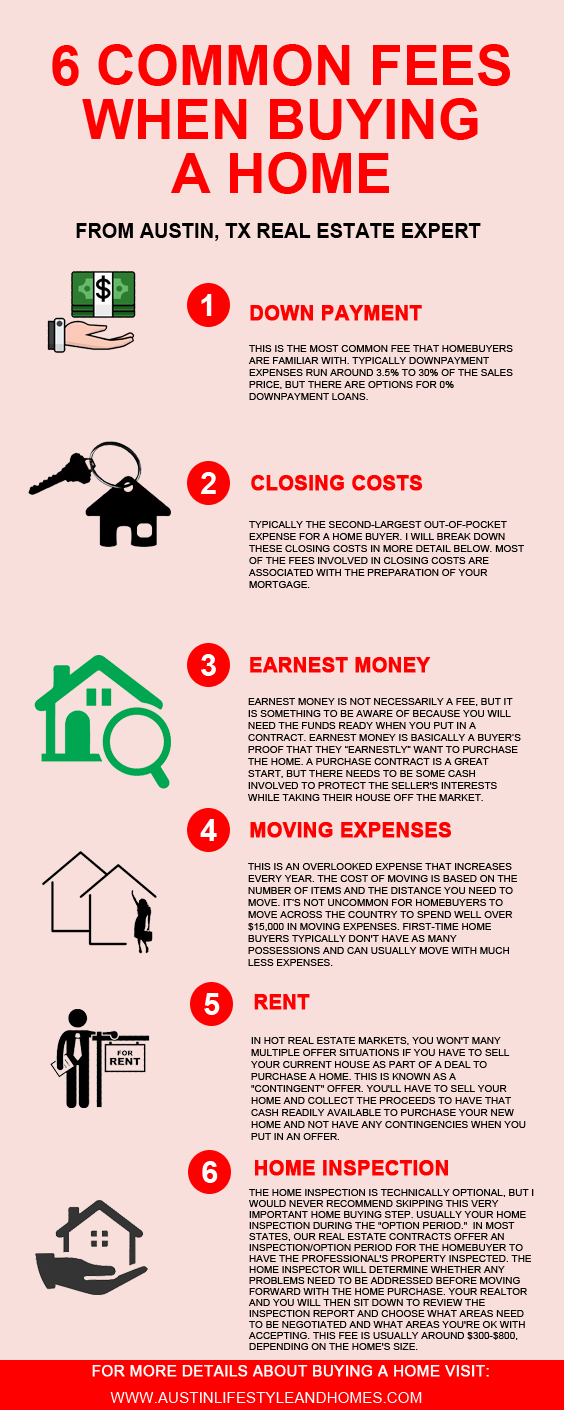
Down Payment – This is the most common fee that homebuyers are familiar with. Typically down payment expenses run around 3.5% to 30% of the sales price, but there are options for 0% down payment loans.
In Austin, with a climbing median home price of $500,000, expect to have anywhere from $25,000 to $150,000 depending on your salary and debt-to-income ratio.
Some homebuyers believe the myth that you need 20% down to purchase a home. The truth is that there are programs that make it possible to buy a home with no down payment if you and the property both meet the loan requirements. The best way to find out home much money you will need for your down payment is to talk to a mortgage lender. You can fill out the form on our loan pre-approval page for Austin to get this process started if you are at that point now.
Earnest Money – Earnest money is not necessarily a fee, but it is something to be aware of because you will need the funds ready when you put in a contract. Earnest money is basically a buyer’s proof that they “earnestly” want to purchase the home. A purchase contract is a great start, but there needs to be some cash involved to protect the seller’s interests while taking their house off the market. In Austin, the earnest money is usually around 1% of the purchase price. Although in multiple offer situations, which are becoming the new normal in Austin’s market, Earnest Money can be significantly higher. A home priced at $450,000 would typically ask $4,500 for earnest money. This $4,500 is credited back to the buyer at closing.
Option Money – Option money is also not necessarily a fee, unless you terminate the contract within the option period. When a home seller accepts your offer, they sign the contract and it is executed, meaning “official.” Congratulations, you’re “under contract.” The option money is provided as payment to the seller to take the home off the market while you perform your due diligence. During this typically 3-7 day period you’ll pay the seller about $50-$100 a day to perform any inspections you want to do, deal with buyer’s remorse, talk to your family, etc…If you decide this isn’t the home for you, you can back-out (i.e terminate) of the contract and your only penalty is the option money. Should you move forward with the contract, your option money, like the earnest money will be credited back to the buyer at closing.
Closing Costs – Typically the second-largest out-of-pocket expense for a home buyer. I will break down these closing costs in more detail below. Most of the fees involved in closing costs are associated with the preparation of your mortgage.
Moving Expenses – This is an overlooked expense increases every year. The cost of moving is based on the number of items and the distance you need to move. It’s not uncommon for homebuyers to move across the country to spend well over $15,000 in moving expenses. First-time home buyers typically don’t have as many possessions and can usually move with much less expenses. More bad news for future Austinites, if you’re coming from other parts of the United States, its a lot more expensive to rent moving trucks to Austin, than leaving Austin.
Home Inspection – The home inspection is technically optional, but I would never recommend skipping this very important home buying step. usually your home inspection during the “option period.” In most states, our real estate contracts offer an inspection/option period for the homebuyer to have the professional’s property inspected. The home inspector will determine whether any problems need to be addressed before moving forward with the home purchase. Your Realtor (me?) and you will then sit down to review the inspection report and choose what areas need to be negotiated and what areas you’re OK with accepting. In Austin, this fee is usually around $300-$800, depending on the home’s size.
Rent – In hot real estate markets, you won’t many multiple offer situations if you have to sell your current house as part of a deal to purchase a home. This is known as a “contingent” offer. You’ll have to sell your home and collect the proceeds to have that cash readily available to purchase your new home and not have any contingencies when you put in an offer. Specific to Austin, there is basically no chance of winning a multiple offer situation if you have to sell your house, so you’ll have to rent something during your home search and rent can become a costly expense.
Mortgage Fees When Buying A Home In Austin
Unless you can pay for your house in all cash, you’re going to have mortgage fees.
The majority of real estate transactions have these fees and these are usually the 2nd highest investment for a homebuyer coming in second to only the down payment. Mortgage fees typically vary from 1% to 6% of the sales price. And these also depend on the type of loan, mortgage structure, down payment amount, and other factors.
Here’s a breakdown of mortgage/lending fees:
Loan Origination Fee – This is the largest fee on the mortgage side. It is the fee that you are paying the lender to generate or “originate” your mortgage. It is essentially the cost you pay the lender you’ve hired to prepare your mortgage for closing.
Discount Points – This is an optional fee that borrowers may be charged to pay down the interest rate. There are many different ways to structure a loan using discount points, so be sure to ask your mortgage lender to explain all your options if you plan on buying down your interest rate.
Application Fee – Some mortgage companies charge a fee to process your loan application for the time they have invested in processing it. Loan officers will process hundreds of applications, and many of them may not be ready for a loan yet. This is especially true when lending requirements are more strict.
Credit Reporting Fee – Some mortgage companies will charge a fee for credit reporting when they check your credit. In many cases, this fee is from a 3rd party service passed on to the homebuyer.
Property Appraisal – To ensure that the mortgage company is lending money on a property that is actually worth the price you have agreed to in the contract, they will order a property appraisal. A professional appraiser will analyze the property to determine its fair market value. If the appraisal comes back reflecting a market value below the contract’s sales price, the buyer and seller will have to negotiate a fix for the problem. This appraisal fee is usually passed on to the buyer since it is a requirement of the loan.
Private Mortgage Insurance – Private mortgage insurance (PMI) is a fee that mortgage companies will charge to protect their interests in cases where they are loaning money for a large portion of the home’s value. In many cases, the PMI will be dropped once a homebuyer’s loan amount becomes less than 80% of the homes fair market value. PMI is usually charged monthly and is an important mortgage fee to research before entering into a loan.
Property Survey – Your mortgage lender may require a survey of the property you are purchasing. They do this to verify the physical specifics of the property and all the real estate specific items on the land before lending money on the property. Many properties will have an existing survey, and in most cases, the lender will accept the previous survey if there have not been any changes to the property. If there is no existing survey, the lender may require one, and this expense is usually passed on to the buyer unless otherwise specified in the sales contract.
Title Company Fees When Buying A Home In Austin, TX
Title company fees will vary by each state, and whether the buyer or seller pays them is negotiated in the sales contract. If you are paying cash for a property, many of these fees are not applicable. In the past it was common for the seller to pay most of the title fees in the Austin area. Like I’ve mentioned before, houses in the $350,000 to $750,000 range are getting multiple offers and often times the buyer agrees to pay alot of the closing costs. We’ll cover all the title fees below as a reference; many local Title Companies websites offer specific estimates.
Title Company and Title Fees
Title Insurance Fees – The title company will issue a Policy insuring the property against defects as to Title, as outlined in their commitment. Their fees are for all the administrative and document expenses required to obtain the items necessary before issuing a Policy.
Title Search – The first thing that a title company does once they receive a new sales contract is to perform a title search. This is a process of searching all previous records of the existing title history for the property.
Recording Fees – The title company will record the deed and any other relevant documents with the county recorders office. This fee will usually be passed on to you at closing.
Owner’s Title Policy – The cost of the Owners Title Insurance Policy is a percentage of the sales price and can be paid for by the buyer or seller, as indicated in the Sales Contract.
Mortgagee Title Policy – A percentage of the sales price also calculates the Title Insurance Policy for the buyer’s mortgage company.
Flood Certificate – This is required in areas where heavy flooding can occur. The fee will vary based on the state.
Escrow Fee – This is the fee that the Title Company charges for their services in processing your file.
Tax Certificates – The Title Company will order tax certificates from the appropriate office to show the payment history and the owed taxes. The Buyer will pay for the taxes from the date of closing through the end of the year, and they may be included in your mortgage payment.
Document Fees – Several documents will need to be prepared for your transaction; these will vary according to your situation but can include the Deed, Deed of Trust, Notice to Purchaser, various Affidavits, and others.
Recording Fees – Some of the documents generated, such as the Deed, will need to be recorded at the County Clerks office; these fees are passed on to the buyer and seller.
Common Home Ownership Fees After Buying A Home In Austin, TX
These are the fees involved with owning a home. These expenses can be a surprise to first-time homeowners if they have previously been renting. Make sure that you are aware of these expenses when purchasing a home.
Home Owner’s Insurance – Your mortgage company requires this expense because it protects their asset (your home). Home Owners insurance will vary based on the policy that you choose but expect it to be at least $1,000+ per year, based on your home’s value. It is commonly escrowed into the monthly mortgage payment.
Property Taxes – This expense can vary greatly based on the state, municipalities, and neighborhood of the home that you purchase. New neighborhoods typically have higher taxes. Some states have property tax rates as high as 6% of the home’s value. In 2019 The City of Austin property tax rate was 44.03 cents per $100 of assessed value. In 2020 it was 55 cents. In 2021 you can bet that will only increase and with rising property values, higher property taxes are a sure thing.
Home Owner’s Association Dues – This expense is only relevant to properties in neighborhoods with a homeowners association. The fee is paid by the neighborhood residents to pay for all neighborhood maintenance and operating expenses. This expense will vary greatly based on the amenities of the subdivision or community that you purchase in. Townhomes and condos can have much higher fees because they typically take care of all the exterior maintenance and lawn care. HOA fees vary drastically, but some estimates claim these fees are between $100 and $700 per month, with roughly $200 as an average. However, fees vary based on what the HOA provides.
Property Maintenance & Repairs – When you rent real estate, most of the repairs are covered by your landlord or property management company. When you own real estate, you are responsible for repair costs, so make sure that you have some money set aside to handle these issues when they arrive. Appliances brake, HVACs need maintenance, and other unexpected things come up when you own your own home.
Home Warranties – You can purchase a home warranty as a way to safeguard yourself from repair expenses in the future. Home warranties are extra protection on top of your home owner’s insurance that usually covers smaller items not covered in your home owner’s insurance policy.
Appliances and Fixtures – The most common items that need replacing in a home are appliances and fixtures. Refrigerators, washer/dryers, ovens, microwaves, ceiling fans, and lighting fixtures are all usually replaced at some point in time. Knowing the value of these items can be very helpful when considering purchasing a home.
Property Updates – If most of the homes for sale in your neighborhood have granite countertops, marble backsplashes, and custom decks, then you will want to have these items in your home when you are ready to sell to ensure that you get top dollar for your home. There is an endless list of potential property updates. Do your research and make sure to update the items that will guarantee a return later when you sell. Please don’t overdo it!
Lawn Services – Lawn equipment, landscaping materials, and lawn maintenance can vary greatly based on your property. I recommend researching these expenses before purchasing a home to know what you are getting into. If you do your own lawn maintenance, you can save anywhere between $40 to $400 per month depending on the size of you yard, number of bushes, tress, etc…
Basic Utilities – Water, gas, and electricity costs can vary from place to place. It is wise to ask for an estimate of utility costs from the owner before purchasing a home you are concerned about. Water fees can vary dramatically in Austin, so make sure to look into this fee before purchasing a home. In some areas in Austin, propane can be very expensive.
Different Types of Home Inspections During A Home Purchase In Austin, TX
Aside from a general inspection, the Inspector might recommend further expertise on certain areas of the home. You can choose to hire more inspections or take a risk. It’s usually worth over inspecting based on the home you are buying.
Here are a few possible inspections and fees you could incur:
- Radon
- Mold
- Structural
- Roof
- Soil
- Termite
- HVAC
- Electrical
- Sewer
- Septic
- Foundation
Rent Expenses Before Buying A House In Austin
Austin is the nation’s 14th most expensive place to rent as of 2020.
With the growing population and popularity, I suspect like home prices, rent will continue to go up.
The average size for a Austin, TX apartment is 865 square feet, but this number varies greatly depending on unit type, with cheap and luxury alternatives for houses and apartments alike. Studio apartments are the smallest and most affordable, 1-bedroom apartments are closer to the average, while 2-bedroom apartments and 3-bedroom apartments offer a more generous square footage.
The cost of living in the capital city is increasingly more expensive, with the average rental cost for a 2-bedroom apartment at $1,541.
Summary: Fees When Buying A House In Austin
From mortgages to title changes, the process of buying a house typically comes with a lot of paperwork to navigate. And with paperwork often comes unexpected fees.
Buying a home can be a good investment, especially in Austin but make sure you understand the fine print costs involved. You should be prepared for all the fees, taxes, charges and various expenditures that you will have to cover before you ever dip your toe into the real estate market.
To avoid being blindsided by any of these costs, it’s a good idea to do your research and ask a lot of questions to both your agent and lender.
These professionals will be able to help you plan ahead for the different costs you will face and give you price estimates specific to your market and the cost of the homes at which you are looking.
On average, closing costs are 2% to 5% of your total home purchase price. However, you should be able to find lower fees if you shop around or negotiate lower fees if you ask your lender. Buying a home is a complicated process. You’ll have to tackle a lot of paperwork and cryptic fees, but you should never be afraid to ask your real estate agent or mortgage lender for help.